


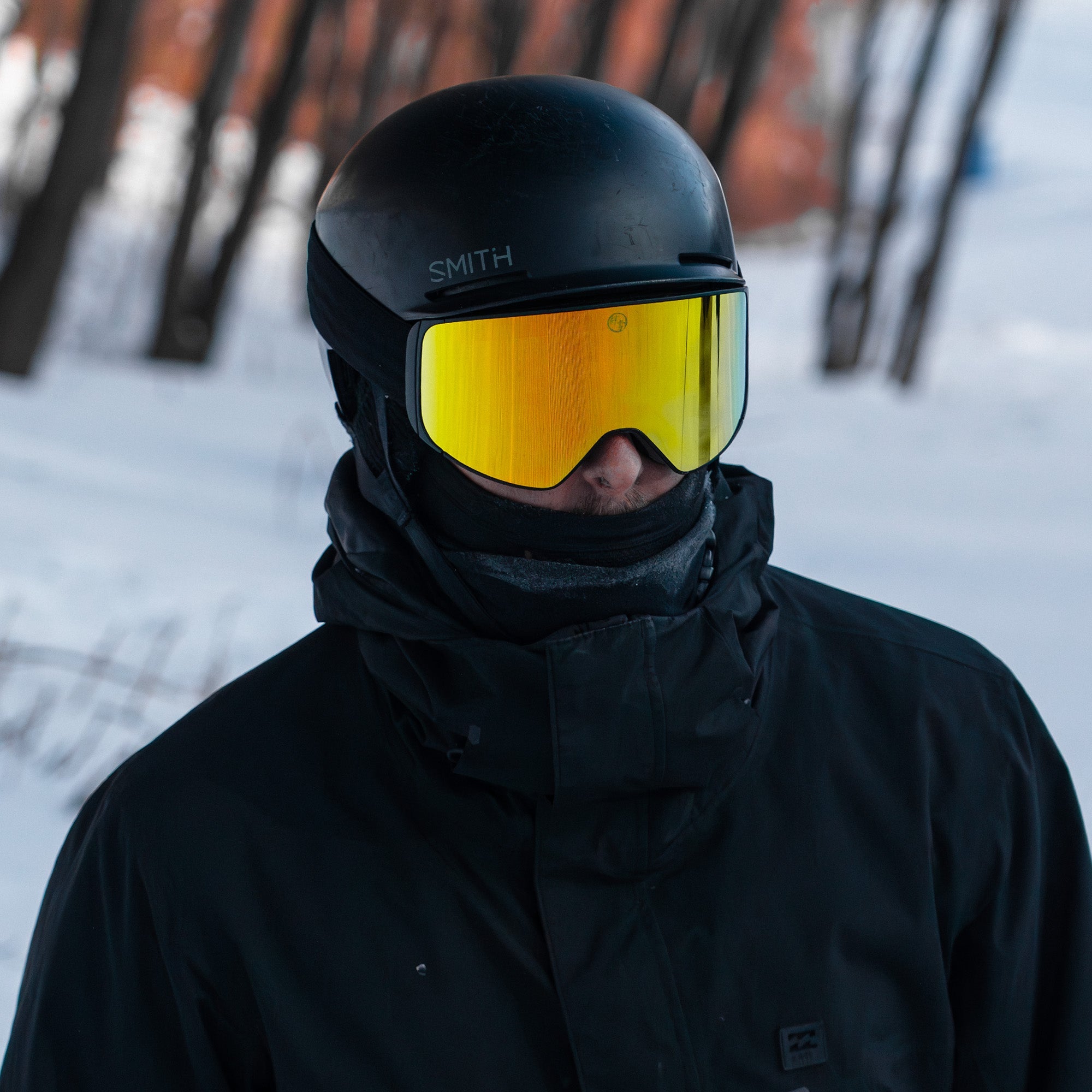
Buying ski goggles online in Australia is straightforward once you know what to check. The key decisions are fit, lens VLT category, helmet compatibility, and whether the goggle supports interchangeable lenses. Get those right and you can shop online with confidence without needing to try anything on first.
Unlike a jacket or a beanie, goggles need to sit flush against your face, suit the light conditions you will be riding in, and work with your helmet. This guide walks through each of those decisions clearly, so you are not guessing when you hit the product page.
What should I look for when buying ski goggles online?
The five things worth checking when buying ski goggles online are face fit, lens VLT rating, helmet compatibility, anti-fog construction, and returns policy. For Australian conditions, lens category is particularly important because alpine weather at resorts like Perisher, Thredbo, Falls Creek, and Mount Hotham can shift from flat overcast light in the morning to bright sun by midday.
Most reputable brands provide enough detail in their product listings for you to make a confident decision. The riders who end up disappointed are usually skipping one of the checks covered below.
How do I get the right fit when buying ski goggles online?
Fit is the most important factor when buying goggles online, and it comes down to two things: face size and foam seal quality.
Goggles are not one size fits all. Most brands offer at least two sizing categories. A regular or standard fit suits medium to larger face shapes. A slim or small fit suits narrower faces, smaller face shapes, or riders who find standard goggles sit too wide or too low on the nose.
If you have ever tried on a standard goggle and felt like it was swamping your face, a slim-fit goggle will likely be the better option.
The KIZUKI Dawn Magnetic Ski Goggle is a regular fit, while the Dawn Slim Magnetic Ski Goggle is designed for a narrower profile. Both use the same magnetic lens system, so the choice comes down to which sits better on your face.
When reading a product listing, look for details on foam type. Triple-layer foam provides a better seal and more comfort than single-layer foam. Strap width and adjustability also matter if you are wearing a helmet.
What lens VLT is best for Australian ski resorts?
For most Australian ski resorts, an S2 lens with a VLT of 19 to 42 percent is the most practical everyday choice. S2 sits in the medium light range and handles variable cloud, mixed light, and changing visibility well, which suits the typical conditions at Australian alpine resorts.
VLT stands for visible light transmission. It tells you how much light the lens lets through. A higher VLT lets in more light and suits overcast or low light conditions. A lower VLT blocks more light and suits bright sunny days.
The S-rating system breaks this down into categories:
| Lens Category | VLT Range | Conditions |
|---|---|---|
| S0 | 80% to 99% | Night riding |
| S1 | 43% to 79% | Low light, heavy overcast, flat light days |
| S2 | 19% to 42% | Medium light, variable cloud, mixed conditions |
| S3 | 8% to 18% | Bright light, sunny days |
| S4 | Under 8% | Intensive light, high altitude, strong sun |
For Australian conditions specifically, S2 is a sensible starting point. If you are only buying one lens and riding across a full season, S2 covers the majority of days well.
For more detail on how lens categories work, the KIZUKI Ski Goggles Lens Guide covers this in full.
Are ski goggles and snowboard goggles the same thing?
Yes. Ski goggles and snowboard goggles are the same product. The terms are used interchangeably. There is no functional difference between a goggle marketed as a ski goggle and one marketed as a snowboard goggle. The same goggle works for both disciplines, so you do not need to buy a different model depending on whether you ski or ride.
Do ski goggles need to be helmet compatible?
Helmet compatibility is important, and it is worth checking before you buy. A helmet-compatible goggle sits flush against your helmet without leaving a gap across the forehead. A gap there lets cold air in and is generally a sign that the goggle and helmet are not working well together.
Most modern ski goggles and helmets are designed with compatibility in mind, but not every combination works. When buying online, look for listings that mention universal helmet fit or helmet compatibility.
A slim-fit goggle frame tends to work more easily across different helmet shapes. If you already own a helmet and are unsure whether a specific goggle will pair with it well, check the brand's FAQ page or reach out before purchasing.
Why do ski goggles fog up, and how do I avoid it?
Ski goggle fogging is caused by the temperature difference between the warm air inside the goggle and the cold air outside it. The fix is double lens construction and good ventilation.
A double lens creates a small insulating air gap between two layers, which reduces the temperature differential that causes fogging. Single lens goggles are more prone to it. When buying online, confirm that the goggle uses a double lens system.
Ventilation channels or frame vents allow air to move across the lens surface. Look for these in the product description. If you tend to run warm or work up a sweat quickly on the mountain, ventilation becomes even more important.
What are magnetic ski goggles and are they worth it?
Magnetic ski goggles use a magnet-based system to attach and release the lens quickly, rather than traditional clips or tabs. The practical benefit is that you can swap lenses in seconds, usually without taking your gloves off.
For Australian riders this matters because conditions change through the day. A lens suited to flat morning light may not be right when the sun breaks through by midday. A magnetic lens system means you can adapt without needing a second pair of goggles.
The KIZUKI Dawn Magnetic Ski Goggle uses a magnetic lens system with a range of interchangeable lenses across different VLT categories. If you want a single goggle that covers mixed conditions across an Australian season, lens interchangeability gives you more flexibility than buying a fixed-lens goggle for each condition.
What is the returns policy when buying ski goggles online in Australia?
KIZUKI accepts returns within 30 days of purchase, as long as the item is unworn, unused, and in its original packaging. For goggles and lenses specifically, the protective inner lens film must remain intact. Once the film has been removed, the item cannot be returned.
For change-of-mind returns, return shipping is at the customer's expense. If the return is due to a fault or mistake by KIZUKI, return shipping is covered. Refunds are processed to the original payment method within 5 to 7 business days once the return has been received and inspected.
KIZUKI does not offer direct exchanges at this time. If you have a question before purchasing, you can reach the team through the contact page. Full details are available on the returns and refunds page.
Quick checklist before you add to cart
| What to Check | What to Look For |
|---|---|
| Face fit | Regular or slim sizing, triple-layer foam, flush seal |
| Lens VLT | S2 for mixed Australian conditions, S1 for low light, S3 for bright sun |
| Helmet compatibility | Universal fit or helmet-compatible noted in listing |
| Anti-fog | Double lens construction, ventilation channels |
| Magnetic lens system | Quick-swap interchangeable lenses for variable conditions |
| Returns policy | Clear window, unworn condition accepted, return path explained |
Ready to shop for ski goggles online in Australia?
Once you know what to look for, buying ski goggles online is a straightforward process. Fit, lens VLT, helmet compatibility, and ventilation cover the majority of what matters. A magnetic interchangeable lens system is worth considering if you want one goggle that adapts across changing conditions through an Australian season.
The KIZUKI ski goggle range includes both regular and slim-fit options with a magnetic lens system designed for Australian alpine riding.
Share:
Ski Goggles Over Helmet: How to Get the Right Fit
Cylindrical vs Spherical Ski Goggle Lenses: What Is the Difference?