


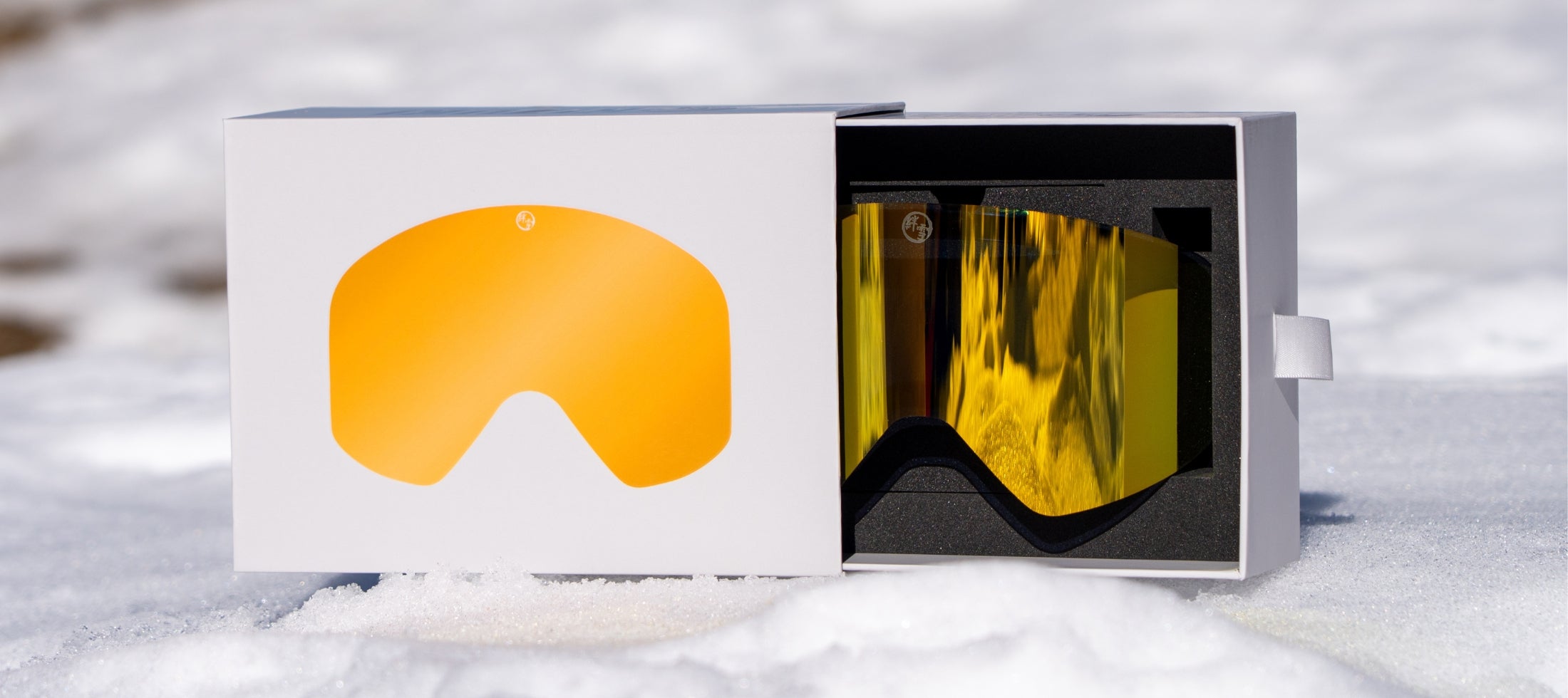
When choosing ski goggles, the lens is the most important factor. The right lens improves visibility, enhances contrast, and helps you see terrain clearly in changing alpine conditions.
Whether you're riding in sun, fog, or flat light, understanding ski goggle lenses will help you choose the best setup for your needs.
Why Ski Goggle Lenses Matter
Ski goggle lenses control how much light reaches your eyes and how clearly you can see the mountain. A good lens improves contrast, reduces glare, and protects your eyes from harmful UV exposure.
Snow reflects up to 80% of UV radiation, making proper eye protection essential in alpine environments.
What Is VLT in Ski Goggles?
VLT (Visible Light Transmission) measures how much light passes through a lens. Lower VLT means less light enters, while higher VLT allows more light in.
- S0 (80–100% VLT): Night or extremely low light
- S1 (40–80% VLT): Overcast, foggy conditions
- S2 (18–43% VLT): Mixed conditions (sun + cloud)
- S3 (8–18% VLT): Bright, sunny days
- S4 (3–8% VLT): Extreme high-alpine sunlight
Most riders spend the majority of their time in variable conditions, which is why S2 lenses are considered one of the most versatile options. Explore magnetic ski goggle lenses designed for all-day performance.
For low light, fog, and whiteout conditions, choosing the right lens becomes even more important. Learn more in our guide to ski goggles for low light conditions.
What Ski Goggle Lens Colour Is Best?
Lens colour affects contrast, depth perception, and terrain visibility. Contrast-enhancing colours perform best across mixed conditions.
- Yellow / Rose / Pink: Enhance contrast in fog and flat light
- Amber / Gold: Balance contrast and brightness
- Grey / Black: Reduce glare in bright sun
- Blue / Green: Maintain natural colour while improving definition
Lens colour plays a major role in contrast and visibility, especially in flat light. For a deeper breakdown, read our guide to ski goggles for low light.
Can One Ski Goggle Lens Work in All Conditions?
Yes, a mid-range VLT lens (S2) can perform well across most conditions, making it a practical choice for riders who want simplicity and versatility.
While dedicated lenses can optimise specific conditions, many skiers and snowboarders prefer a single lens that adapts throughout the day. Systems like the KIZUKI Dawn Magnetic Ski Goggle are designed with this versatility in mind.
What to Look for When Buying Ski Goggles
Lens Technology
Look for dual-layer construction and anti-fog coatings to maintain clear vision.
UV Protection
Always choose lenses with UV 400 protection to block 100% of UVA and UVB rays. Learn more about our certified protection standards.
Field of View
A wider lens improves peripheral vision and awareness on the mountain. Learn why this matters in our guide to ski goggles with a wide field of view.
Lens Interchangeability
Magnetic lens systems allow fast swapping in changing conditions. Browse goggle accessories to complete your setup.
Fit and comfort can vary depending on face shape and preferences. For a more tailored approach, explore our guide to ski goggles for women.
If you wear prescription glasses, you may need a specific fit. Learn more about OTG ski goggles designed to fit over glasses comfortably.
The KIZUKI Lens Approach
Most brands promote multiple lenses for different conditions. KIZUKI simplifies the experience with a versatile, all-condition approach.
One VLT, All Conditions
All KIZUKI lenses use S2 VLT performance, providing a balance between brightness and glare reduction across mixed conditions.
Eight Signature Lens Colours
Available in both Standard and Slim, each lens is compatible with the Dawn and Dawn(s) magnetic ski goggles.
- Glacial Blue – Standard | Slim
- Horizon Red – Standard | Slim
- Alpine Pink – Standard | Slim
- Summit Gold – Standard | Slim
- Forest Green – Standard | Slim
- Twilight Rose – Standard | Slim
- Blizzard Silver – Standard | Slim
- Midnight Black – Standard | Slim
Your colour, your statement.
With consistent S2 VLT performance across all lenses, each option is designed to adapt seamlessly to changing conditions while reflecting your personal style.
Built for Performance on the Mountain
Ski goggle performance comes down to how well your lens handles real conditions. From changing light to moisture and impact, the right lens system keeps your vision clear and consistent throughout the day.
KIZUKI lenses are designed to perform across these variables, combining clarity, protection, and usability in one system.
Magnetic Lens System
Switching lenses should be quick and effortless, especially with magnetic ski goggles designed for changing alpine conditions.
- Fast, magnetic lens interchangeability
- Swap lenses while wearing or holding your goggles
- Secure hold designed to stay locked in, even during impact
Certified UV 400 Protection
Eye protection is critical in high-altitude environments where UV exposure is significantly stronger. Learn more about our certified UV protection standards.
- Blocks 100% of UVA and UVB radiation
- Protects against long-term sun damage
- Finished with an anti-reflective REVO coating to reduce glare
Advanced Anti-Fog Lens Construction
Fogging is one of the most common issues riders face. A high-performance lens system helps maintain clarity in wet, cold, and high-output conditions. For care tips, read our guide on how to clean ski goggles.
- Dual-layer lens construction to regulate temperature
- Engineered to perform up to 7× above standard anti-fog benchmarks
- Designed to minimise internal condensation during use
Cylindrical Lens Shape & Wide Field of View
Visibility isn’t just about clarity. It’s about how much of the mountain you can see at once. Learn more in our guide to ski goggles with a wide field of view.
- Cylindrical lens design for a wide, unobstructed view
- Improved peripheral awareness on busy slopes
- Better depth perception to read terrain more accurately
Ski Goggles vs Snowboard Goggles
There is no difference between ski goggles and snowboard goggles. Both are designed for the same purpose: protecting your eyes and improving visibility in snow conditions.
The terms are interchangeable, and performance depends on lens quality rather than the label.
Final Thoughts
Choosing the right ski goggle lens doesn’t need to be complicated.
Understanding VLT, lens colour, and conditions gives you the foundation to make the right decision. From there, it’s about choosing a system that fits how you ride.
KIZUKI simplifies that decision. With consistent S2 performance, advanced lens technology, and a magnetic system built for real conditions, explore our full range of ski goggles built for clarity, confidence, and all-day performance.
Share:
Ski Goggles for Low Light: Best Lenses for Overcast, Fog & Whiteout Conditions
The Ultimate Snow Gear Guide in Australia: What You Actually Need on the Mountain